01
Direct engineering values
Supported sensors can provide °C, bar, mm, l/min, position or level directly to the PLC.
Build a digital point-to-point sensor layer that carries process values, parameters and diagnostics between field devices and the controller, while using the correct master, modules and IIoT route for the machine architecture.
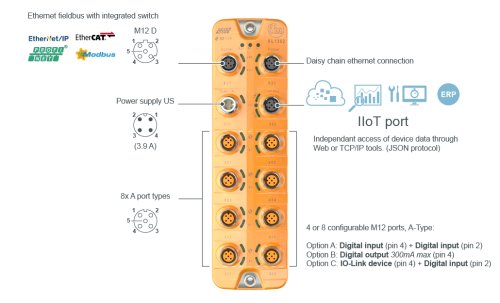
IO-Link is not an Ethernet fieldbus at the device port. The master terminates the point-to-point device links and bridges them to the selected industrial network and, on suitable masters, to IIoT interfaces.
The value comes from combining precise process data with remote parameterisation, device identity and diagnostic information.
Supported sensors can provide °C, bar, mm, l/min, position or level directly to the PLC.
Vendor/device identifiers, article number and serial information can support machine validation.
Configure switch points, scaling and selected device behaviour and restore parameters after replacement.
Status bits and event information expose device issues and application changes on supported devices.
The system usually combines devices, a master and optional field modules. Higher-level software is selected separately.
Gateway from field devices to the selected PLC network; current ifm portfolio includes DataLine, PerformanceLine, CabinetLine and SolutionBlock.
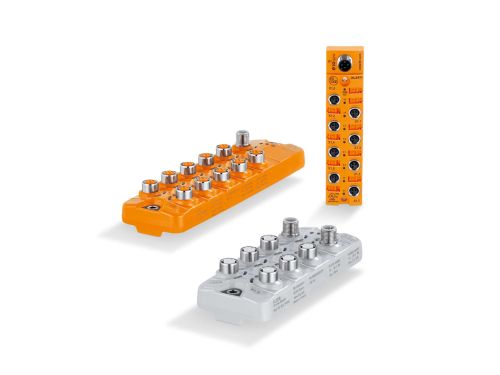
Bring conventional digital, analogue and actuator signals into an IO-Link topology without running every signal back to the cabinet.
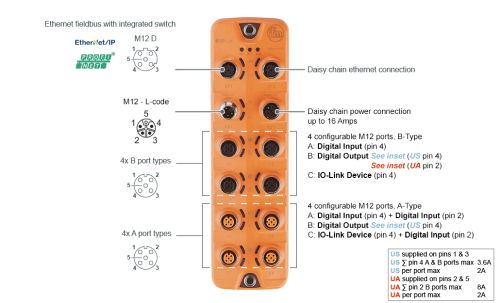
Use AL14xx when higher actuator current, L-coded power and configurable B-port architecture are central to the application.
Process values used continuously by the controller are cyclic. Parameters and identification are normally exchanged acyclically. Events communicate device or application status changes. The IODD describes the device data model and parameters.
Prioritise applications where configuration effort, diagnostics, additional process data or repeated machine builds justify the architecture.
Parameter backup and repeatable configuration reduce commissioning variation across series machines.
A smart process sensor can provide primary and secondary process values plus status without extra analogue channels.
Make diagnostics, temperature, counters or consumption data available to analytics layers.
Start with the PLC/network and field-device count. Do not start by choosing a master only from port count.