01
Differentiate coating from medium
Impedance spectroscopy allows the sensor to evaluate the electrical signature of the actual medium rather than react only to deposits.
Use impedance spectroscopy for reliable point-level detection in hygienic and demanding processes where residue, foam, splash or changing media can challenge conventional switches. Current LMT variants are programmable through IO-Link and are available with media-specific factory settings.

The LMT is strongest when the application needs to distinguish actual medium contact from process disturbances that can cause false switching in simpler point-level technologies.
Impedance spectroscopy allows the sensor to evaluate the electrical signature of the actual medium rather than react only to deposits.
Suitable LMT applications can ignore common foam and splashing conditions that would otherwise mimic a level event.
IO-Link process values can help distinguish product, cleaning media and buildup where the media signatures are sufficiently different.
Current variants are factory-set for water-based, oil/powder or high sugar/salt media groups and remain programmable through IO-Link.
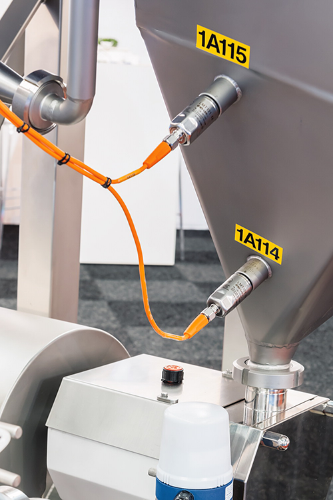
Use LMT as an independent switching point for overflow prevention, minimum level or process interlocks.
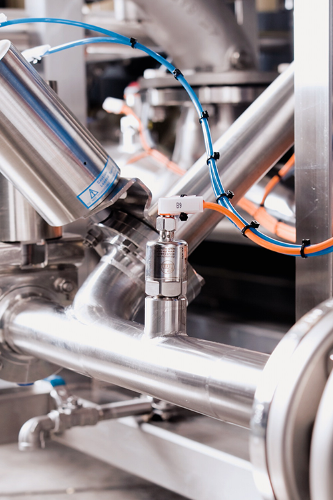
Confirm that product is present at the pump inlet or critical pipe point before permitting operation.

Use IO-Link process values where the application needs to distinguish product, cleaning medium or residue.

LMT evaluates how the medium affects an electrical field across several frequencies. Conductance, permittivity and attenuation contribute to the resulting signature, allowing the sensor to separate actual medium contact from many deposits and disturbances.
Adjust the sensor when the factory media preset is not the final process setting.
Read the impedance-derived process value to support media differentiation and troubleshooting.
Use device identification and digital parameter access within an IO-Link architecture.
| Model | Probe length | Process connection | Factory setting |
|---|---|---|---|
| LMT100 | 11 mm | G1/2 sanitary cone | Water-based liquids |
| LMT102 | 38 mm | G1/2 sanitary cone | Water-based liquids |
| LMT104 | 153 mm | G1/2 sanitary cone | Water-based liquids |
| LMT105 | 253 mm | G1/2 sanitary cone | Water-based liquids |
| LMT110 | 11 mm | G1/2 sanitary cone | Oil-based liquids / powders |
| LMT121 | 11 mm | G1/2 sanitary cone | High sugar / salt liquids |
| LMT202 | 28 mm | G3/4 BSPP | Water-based liquids; tuning-fork retrofit |
| LMT302 | 38 mm | G1 BSPP | Water-based liquids; tuning-fork retrofit |
| Requirement | Technology route | Reason |
|---|---|---|
| Hygienic point-level with residue / foam challenges | LMT | Primary fit Impedance spectroscopy and media differentiation |
| Continuous tank level | LR / radar / other continuous family | LMT provides a switching point, not a continuous level profile |
| Simple standard point level | LMC / capacitive / other point-level route | May be more appropriate when hygienic/media-differentiation capability is not needed |
| Non-contact measurement | Radar / ultrasonic route | No wetted point-level probe |