1D and 2D codes
Read common 1D/2D codes independent of their rotational position within the configured image.
Read and verify 1D/2D codes, printed characters and text for product identification, traceability and process control. O2I combines industrial image capture, integrated illumination and ifm Vision Assistant logic for applications that need more than a simple barcode presence signal.
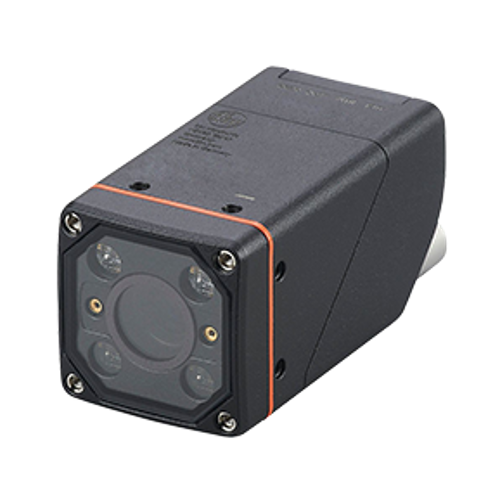
O2I5 is designed for traceability and product-control tasks where code content, text or position must be evaluated rather than simply detecting that a mark exists.
Read common 1D/2D codes independent of their rotational position within the configured image.
Read and verify characters such as serial numbers, dates and product markings.
Use multiple image settings and polarisation/illumination options for changing colour, gloss or contrast.
Compare read content against expected values and generate OK/not-OK results in Vision Assistant logic.
O2I is strongest when the code or text is part of the production decision: component identity, batch/date validation, process routing or automated sorting.
Read manufacturing dates, expiry dates, serialisation and product IDs.
Compare code content with production data before welding, assembly, filling or another controlled step.
Read carrier, package or product codes to route material and reduce manual identification errors.
The reader is selected around working distance, field of view, mark type, code size, target speed and the communication route. O2I5 also offers multiple image settings and monitoring functions to keep the read process stable.
The current O2I5 family includes standard, wide-angle and telephoto lenses with visible-red or infrared illumination. Representative fieldbus variants are shown below; final order number depends on the required protocol.
| Lens | Typical operating distance | Light | EtherNet/IP / TCP/IP | PROFINET / TCP/IP |
|---|---|---|---|---|
| Standard | 85…2000 mm | Red / IR | O2I500 / O2I501 | O2I510 / O2I511 |
| Wide-angle | 35…1000 mm | Red / IR | O2I502 / O2I503 | O2I512 / O2I513 |
| Telephoto | 200…4000 mm | Red / IR | O2I504 / O2I505 | O2I514 / O2I515 |
Optical identification is not automatically the best traceability technology. The marking, line-of-sight, environment and amount of data determine the route.
| Requirement | Route | Use when |
|---|---|---|
| Read visible 1D/2D codes and OCR | O2I | Line-of-sight marking is available and code/text is the main task. |
| Code + object inspection via IO-Link | O2U | One vision sensor should combine identification and inspection. |
| Identification without line of sight / reusable carrier memory | RFID | Tag-based tracking is more appropriate than visible marking. |
| Contour/surface inspection only | O2D5 | The job is quality inspection rather than identification. |
Send actual sample codes or text if available. Readability depends heavily on mark quality, contrast, size and working distance.