01
Colour independent
Detection is based on the return of sound rather than visible-light reflection, helping with changing colours and finishes.
Contactless position, distance and level sensing for targets that are difficult for optical technologies. Ultrasonic sensing is largely independent of target colour, transparency and optical reflectivity, with current ifm routes spanning compact M18 housings through long-range M30 and robust full-metal designs.

ifm positions ultrasonic sensing for targets and surfaces where conventional optical detection can become application-sensitive. Selection still depends on range, blind zone, target geometry and the acoustic environment.
Detection is based on the return of sound rather than visible-light reflection, helping with changing colours and finishes.
Suitable routes are available for transparent bottles, glass and other targets that can challenge conventional photoelectric sensing.
Selected sensors provide continuous distance information through analogue output or IO-Link rather than only an on/off state.
The wider acoustic beam can be useful for uneven, structured or irregular targets where a pinpoint optical spot is undesirable.
The strongest applications are those where non-contact sensing is needed and the target provides a usable acoustic return.
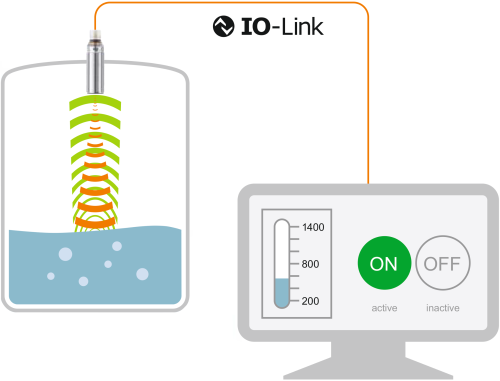
Continuous non-contact measurement can be used for open tanks, bins and vessels when the acoustic path and target surface are suitable.
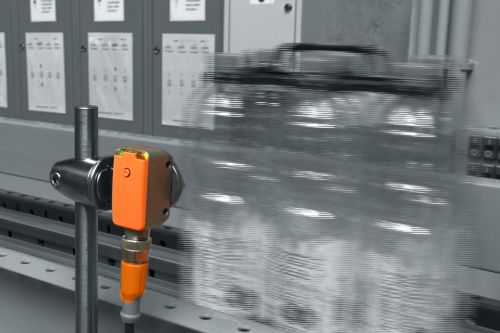
Ultrasonic sensing avoids dependence on the optical transparency or colour of the target, provided the target geometry returns sound reliably.
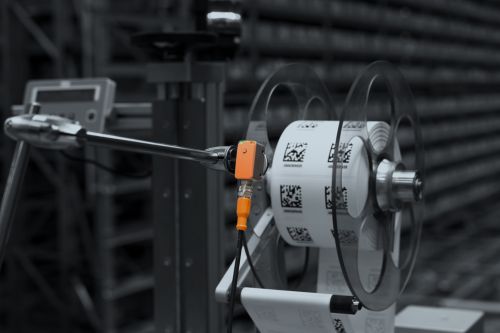
Monitor changing roll diameter on paper, film and web handling applications without readjusting for colour or reflective coating changes.

When a diffuse sensor cannot obtain a stable return echo, a retro-reflective ultrasonic route can detect interruption of a defined reflected signal.
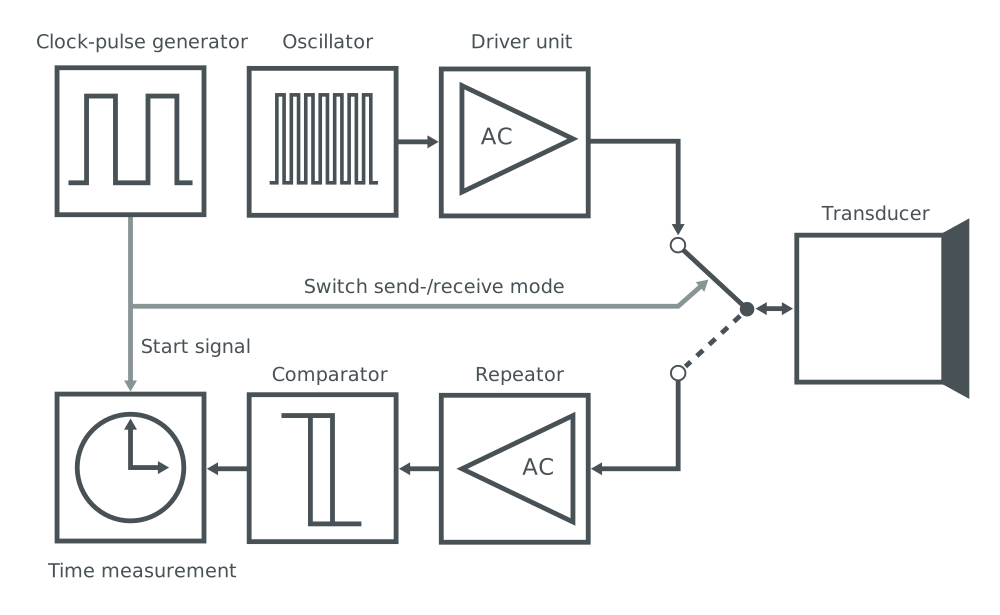
The transducer sends an ultrasonic burst and then receives the echo returned by the target. The elapsed time is converted into distance using the speed of sound. In simplified form, distance is calculated as d = c × t / 2.
These are family-level selection routes from ifm's current ultrasonic portfolio. Exact switching ranges, blind zones, outputs and materials must be confirmed on the selected order number.
Compact 60 mm M18 housing route for general position and level sensing.

Longer M18 housing options extend the sensing range while retaining an industry-standard threaded format.

Use the larger M30 sensing head where the application requires substantially longer stand-off distance.
A space-saving alternative with an M18 threaded nose or through-hole mounting options, depending on the selected model.
All-metal stainless steel sensing-face variants are intended for increased robustness in harsh environments. Exact compatibility still depends on the medium, mounting and environment.
Use these values to narrow the technology and housing route. Final specification must be taken from the selected ifm order-number datasheet.
Blind zone, target size, beam width, orientation, speed, mounting distance to neighbouring ultrasonic sensors and environmental airflow can determine whether a nominally suitable range will work reliably.
Ultrasonic is robust against many optical variables, but it is not immune to target and environmental constraints.
Diffuse ultrasonic sensors need a minimum distance in front of the sensing face to generate, receive and evaluate the sound signal.
Sound-absorbing materials or surfaces that deflect the echo away from the sensor can reduce reliability. Retro-reflective sensing may be a better route for some targets.
Strong wind, compressed-air flow or cooling fans can disturb sound propagation. Shield the acoustic path where necessary.
Diffuse ultrasonic switching is generally not the first choice for very high-speed targets; confirm the product switching frequency against the machine cycle.
Very small targets can be better suited to laser or photoelectric sensing. Use the sensor's response curve to confirm the usable detection zone.
Multiple ultrasonic sensors mounted too close together can interfere. Respect the product installation spacing and synchronisation guidance where applicable.
Ultrasonic is valuable when optical target characteristics vary, but another technology may be stronger for tiny targets, very high switching speeds or materials that absorb sound.
| Application need | Technology route to review | Why | Key check |
|---|---|---|---|
| Transparent / different-colour objects | Ultrasonic | Detection is not based on visible-light reflectivity or colour. | Target must return a usable acoustic echo. |
| Open tank liquid / bulk-solid level | Ultrasonic | Non-contact continuous distance measurement. | Foam, vapor, surface geometry, turbulence and range. |
| Tiny high-speed target | Photoelectric / laser route | Smaller spot and higher switching speed can be advantageous. | Target colour/reflectivity and background. |
| Sound-absorbing or angled target | Retro-reflective ultrasonic or alternative optical route | Diffuse acoustic echo may be weak or deflected. | Reflector position and available installation geometry. |
| Metal target at short range | Inductive | Simple short-range metal detection may not need distance measurement. | Target material and required sensing distance. |
Share the application geometry rather than only asking for a distance range. It materially improves sensor and mounting selection.