Frequency-selective monitoring
Configure narrowband objects around rotational, bearing, gear or process-related frequencies instead of watching only one overall value.
Programmable vibration edge controllers for complex machine and process monitoring. VSE evaluates up to four dynamic vibration signals, combines them with process variables, and performs configurable monitoring in both time and frequency domains.

VSE places the diagnostic logic close to the machine. Raw acceleration signals can be converted into specific condition parameters so only useful machine-health information needs to travel through the automation network.
Configure narrowband objects around rotational, bearing, gear or process-related frequencies instead of watching only one overall value.
Bring speed, pressure, temperature or other auxiliary signals into the monitoring strategy to account for changing machine operating states.
Use configurable condition parameters and outputs for pre-alarm, main alarm or protection functions in milliseconds.
Connect machine diagnostics to PLC/fieldbus systems while also exposing relevant data to higher-level monitoring and software environments.
Monitor spindle bearings, tool wear, unbalance and crash events where high process forces make simple overall-vibration thresholds insufficient.
Separate unbalance, bearing, gear, liquid and process-related vibration components and evaluate them against the relevant operating state.
Use vibration plus pressure, flow or load-related auxiliary variables for load-dependent diagnosis on screw and reciprocating machines.
Monitor multiple shafts, transmission ratios and individual narrowband components in machines with complex kinematics.

The VSE platform accepts dynamic vibration signals from suitable acceleration sensors and can use auxiliary process values such as speed, pressure or temperature. Diagnostic logic is configured in the controller and selected results are passed to the PLC and IT environment.
| Protocol | IP20 cabinet | IP67 field | Selection note |
|---|---|---|---|
| PROFINET | VSE150 | VSE950 | For PROFINET-based automation architectures. |
| EtherNet/IP | VSE151 | VSE951 | For EtherNet/IP control systems. |
| Modbus TCP | VSE153 | VSE953 | For Modbus TCP integration. |
| EtherCAT | VSE152 | — | Cabinet route listed in the current ifm selection guide. |
| TCP/IP | — | VSE903 | Field-mounted TCP/IP route. |
IP20 controller family for control-cabinet installation with protocol-specific variants.
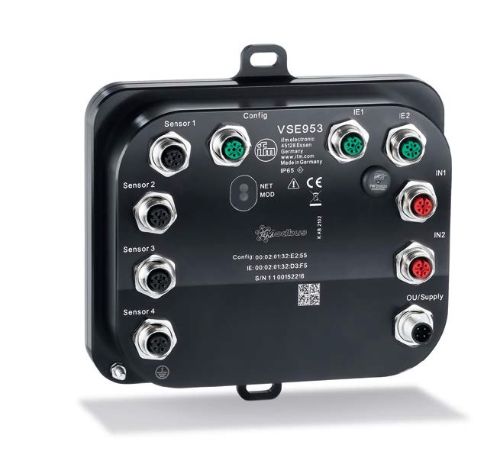
IP67 decentralised route with standard M12 connections for faster field installation and retrofit.
VSE is diagnostic electronics; it is not itself the vibration sensor. The connected acceleration sensor determines measuring range, frequency response, mounting and environmental suitability.
Robust sensor route for connection to VSE, including versions for difficult mounting locations and integrated self-test functionality.
MEMS-based multi-axis acceleration route with IEPE output for radial and axial vibration measurement.
Suitable VSP variants provide IEPE acceleration measurement; intrinsically safe VSP0xA versions require the documented barrier and ATEX installation approach.
Do not select VSE only by communication protocol. Number and location of accelerometers, machine kinematics, speed information, auxiliary variables and diagnostic objects determine the architecture.