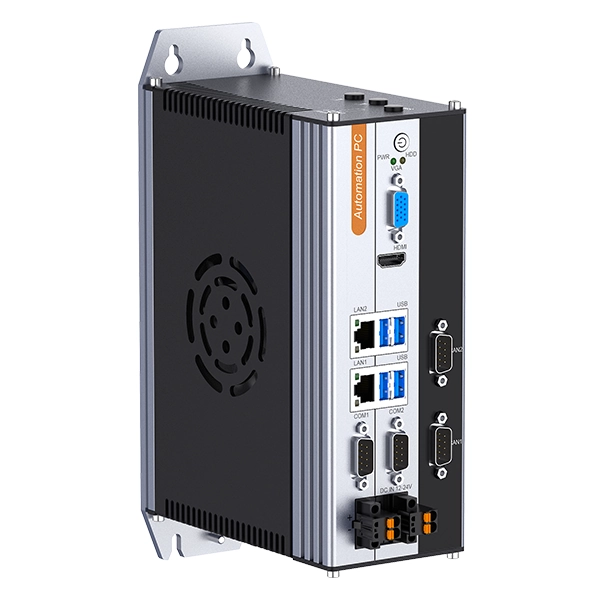
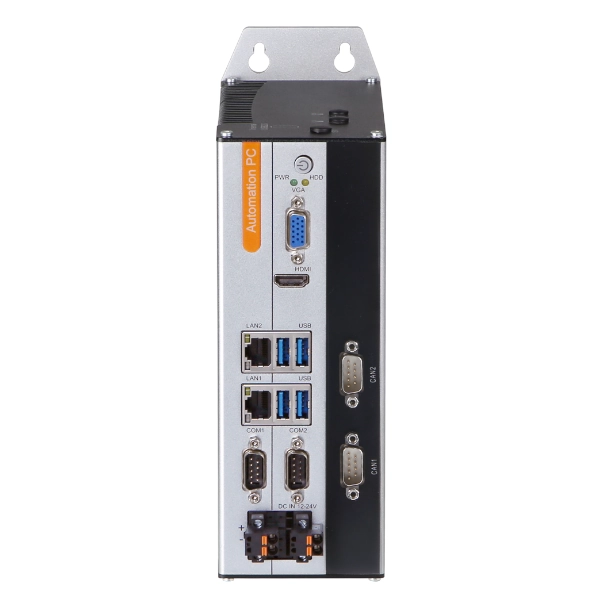
NP-6135-CAN2 Ultra Automation PC
A Core Ultra control-cabinet automation PC with two CAN 2.0A/B channels for machine, robotics and vehicle-subsystem integration. The platform combines an Intel Core Ultra 5 125H or Core Ultra 7 255H processor with DDR5 memory, integrated Intel Arc graphics, Intel AI Boost, dual Gigabit Ethernet, dual RS232/RS485, dual SATA storage interfaces and protected 12–24 VDC input.
| Model | Processor | Memory | CAN | Network / serial |
|---|---|---|---|---|
| NP-6135-CAN2-125H | Intel Core Ultra 5 125H · 14 cores / 18 threads · 28 W processor base power | 2 × DDR5-5600 SO-DIMM · up to 96 GB | 2 × CAN 2.0A/B via Mini PCIe expansion architecture | 2 × Intel i210-AT GbE · 2 × RS232/RS485 |
| NP-6135-CAN2-255H | Intel Core Ultra 7 255H · 16 cores / 16 threads · 28 W processor base power | 2 × DDR5-5600 SO-DIMM · up to 96 GB | 2 × CAN 2.0A/B via Mini PCIe expansion architecture | 2 × Intel i210-AT GbE · 2 × RS232/RS485 |
Deployment Capabilities
CAN-connected automation
Two CAN 2.0 A/B channels connect drives, motion devices, robotics subsystems, mobile equipment and supported vehicle networks.
Modern local compute
Core Ultra processors, integrated graphics and Intel AI Boost support supervisory applications and local analytics.
Multi-protocol integration
Dual Ethernet, dual RS232/RS485 and CAN allow one cabinet computer to coordinate multiple equipment layers.
Secure and serviceable deployment
TPM 2.0, socketed DDR5 memory and dual SATA storage interfaces support maintainable industrial installations.
Technical Features
Dual CAN 2.0 A/B
Two CAN channels are provided through the platform expansion architecture for machine, robotic or vehicle-subsystem communication.
Intel Core Ultra processing
125H and 255H options provide current x86 performance, integrated graphics and an NPU for supported workloads.
DDR5 memory
Two DDR5-5600 SO-DIMM sockets support up to 96 GB total memory according to the published platform specification.
Ethernet and serial communication
Dual Intel i210-AT Gigabit Ethernet and dual RS232/RS485 ports support industrial network and field-device connectivity.
Dual storage
mSATA and M.2 2280 SATA interfaces support separate operating-system and application-data storage.
Industrial mechanical design
The fan-assisted aluminium-magnesium chassis supports wall or DIN-rail mounting and published -20 to +60 °C operation with airflow.
Specifications
| Parameter | Unit | Value / Description |
|---|---|---|
| SYSTEM | ||
| Processor options | — | Intel Core Ultra 5 125H: 14 cores / 18 threads, P-core base 1.2 GHz, E-core base 700 MHz. Intel Core Ultra 7 255H: 16 cores / 16 threads, P-core base 2.0 GHz, E-core base 1.5 GHz. |
| Processor base power | W | 28 for both processor options. |
| BIOS | — | AMI UEFI BIOS. |
| Memory | GB | 2 × DDR5-5600 SO-DIMM; platform capacity up to 96 GB. |
| Graphics | — | Core Ultra 5 125H: integrated Intel Arc graphics. Core Ultra 7 255H: Intel Arc 140T GPU. |
| NPU | — | Intel AI Boost. |
| Peak AI performance | INT8 TOPS | Core Ultra 5 125H: 33 overall, including 18 GPU and 11 NPU TOPS. Core Ultra 7 255H: 96 overall, including 74 GPU and 13 NPU TOPS. These are processor-level theoretical peak values; application performance depends on software and workload. |
| Watchdog | — | Programmable, 1–255 levels. |
| Security | — | Discrete TPM 2.0, SLB9672XU2.0. |
| COMMUNICATION, DISPLAY & STORAGE | ||
| CAN | — | 2 × CAN 2.0A/B channels, implemented through the Mini PCIe expansion architecture. |
| Ethernet | — | 2 × Intel i210-AT Gigabit Ethernet controllers. |
| Serial | — | 2 × RS232/RS485 ports; maximum published baud rate 115.2 kbit/s. |
| USB | — | 4 × USB 3.0 plus 1 × internal USB 2.0 Type-A for a USB dongle. |
| Display | — | VGA up to 1920 × 1080 @ 60 Hz and HDMI up to 3840 × 2160 @ 60 Hz. |
| Storage interfaces | — | 1 × mSATA SATA 3.0 and 1 × M.2 2280 Key-B SATA 3.0. |
| Expansion | — | 1 × full-size Mini PCIe slot with SIM-card holder. In the CAN2 configuration, the CAN implementation uses the applicable Mini PCIe expansion architecture; confirm remaining slot availability for the ordered configuration. |
| Remote switch | — | 1 × remote switch connection (SW). |
| POWER, OS & MECHANICAL | ||
| Input voltage | VDC | 12–24 VDC ±10% with overcurrent, overvoltage and reverse-polarity protection. |
| Maximum power consumption | W | 90. |
| Operating systems | — | Microsoft Windows 10 and Windows 11; Linux distributions including Ubuntu and Debian. |
| Construction and mounting | — | Aluminium-magnesium alloy enclosure with fan-assisted cooling; wall-mount or DIN-rail installation. |
| Dimensions (L × W × H) | mm | 200 × 150.5 × 74.6. |
| Net weight | kg | 1.9. |
| ENVIRONMENT & COMPLIANCE | ||
| Operating temperature | °C | -20 to +60 with airflow and SSD storage. |
| Storage temperature | °C | -40 to +80 with airflow and SSD storage. |
| Relative humidity | — | 95% RH at 40 °C, non-condensing. |
| Operating vibration | — | 5–500 Hz, 3 Grms with SSD and wall mounting; IEC 60068-2-64 reference. |
| Operating shock | — | 30 G peak acceleration, 11 ms duration, with SSD and wall mounting; IEC 60068-2-27 reference. |
| EMC | — | CE EMC; IEC/EN 61000-6-2, IEC/EN 61000-6-4 and FCC Class A references. |
| Safety | — | IEC/EN 62368-1 reference. |
Applications
Robotics and motion systems
Connect CAN-based drives, motion modules, encoders or robotic subsystems while running supervisory software locally.
Mobile machinery
Integrate CAN-connected equipment, operator applications and Ethernet services in off-highway or specialized mobile systems.
Vehicle subsystem benches
Acquire and control supported CAN-based subsystems during component integration and automated bench testing.
Machine gateways
Bridge CAN, serial and Ethernet equipment while executing protocol conversion, buffering and local diagnostics.
Industrial data acquisition
Collect network and process data from CAN devices, serial instruments and Ethernet controllers on one platform.
Automated test and validation
Coordinate CAN stimuli, instruments, fixtures and report generation from a cabinet-mounted x86 computer.
Similar Products
All Estone products →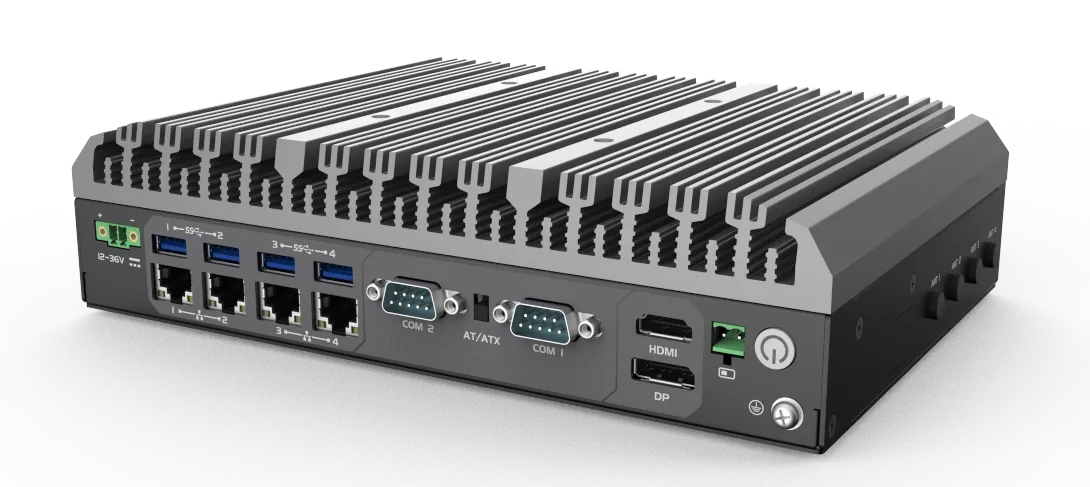
Estone fanless Alder Lake-U industrial computer with four LAN ports, dual configurable serial interfaces, NVMe and 2.5-inch storage, 5G Through Primionics India.
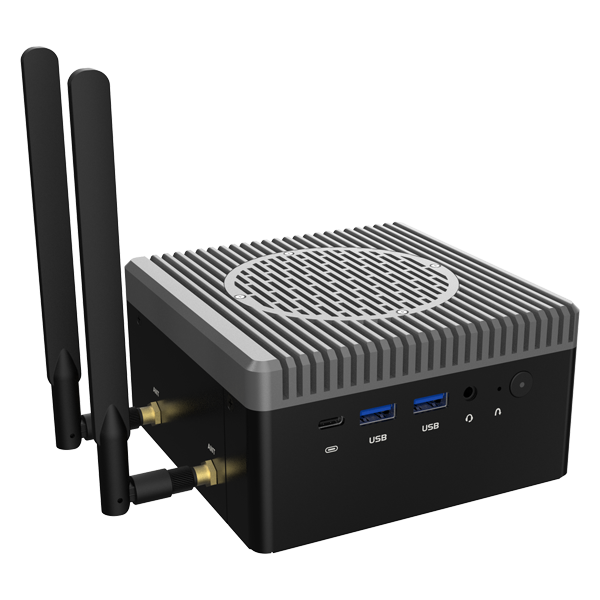
Estone compact industrial computer with Intel Core Ultra processing, four-display support, PCIe Gen4 NVMe/SATA storage, dual Gigabit Ethernet Through Primionics India.
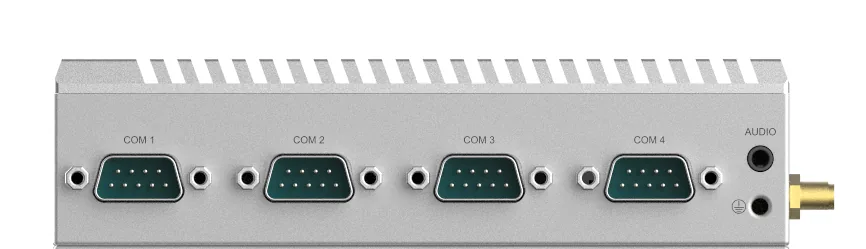
Estone fanless industrial computer with Intel Elkhart Lake J6413, dual display, four configurable serial ports, dual 2.5GbE and cellular Through Primionics India.