
PCIe Fabric Software
Turn a PCIe fabric into an application platform with shared memory, sockets, IP, device access and management interfaces matched to the software team.
System Capabilities
Multiple programming models
Select shared memory, DMA, sockets or IP according to application architecture and integration effort.
Controlled data movement
Map memory and use supported DMA paths where direct application control is required.
Remote resource interfaces
Access compatible memory regions and PCIe devices through the supported fabric services.
Fabric visibility
Use management and diagnostic tools to inspect adapters, links, topology and selected error conditions.
Technical Features
SISCI API
Create and map local or remote memory segments, signal events, move data with DMA and configure peer-to-peer device transfers through a maintained C API.
SuperSockets
Run supported Berkeley-socket applications over the PCIe fabric with lower communication overhead than a conventional Ethernet path.
IPoPCIe
Expose a standard IP interface over PCIe for services that need familiar TCP/IP semantics rather than a custom shared-memory API. IPoPCIe is available for Linux and Windows, but the current driver does not provide Linux-to-Windows IPoPCIe communication.
SmartIO
Access compatible PCIe devices in local, remote or fabric-attached locations. Device Lending presents a borrowed device to one host through its native driver, while the SISCI SmartIO extension supports application-managed access models. Current published SmartIO and Device Lending deployment information is centred on Linux; Windows Hot-Add is a separate capability and SmartIO availability must be checked by release.
Reflective memory and multicast
Create software-defined memory regions in system RAM and distribute updates using hardware multicast on compatible switch configurations.
Management and diagnostics
Configure adapters, inspect topology, monitor link state and collect error information using platform-specific board-management tools.
Specifications
| Parameter | Unit | Value / Description |
|---|---|---|
| SOFTWARE COMPONENTS | ||
| SISCI | — | Shared memory, events, interrupts, DMA, remote memory and peer-to-peer configuration. |
| SuperSockets | — | Berkeley-socket-compatible interface accelerated over supported PCIe fabrics. |
| IPoPCIe | — | TCP/IP networking interface implemented over the PCIe interconnect. Linux and Windows implementations are available, but the current IPoPCIe driver does not communicate between Linux and Windows hosts. |
| SmartIO | — | Remote device access, exclusive native-driver Device Lending and SISCI SmartIO application-managed access; SR-IOV virtual functions may be assigned independently where supported. Current published SmartIO and Device Lending support is principally Linux-based. |
| FABRIC FUNCTIONS | ||
| Reflective memory | — | Application-defined system-memory regions distributed through compatible multicast hardware. |
| Peer-to-peer | — | Configuration of direct transfers between supported GPUs, FPGAs, NVMe and other PCIe bus masters. |
| Topology management | — | Adapter, switch and link status with diagnostics on supported products. |
| Hardware scope | — | Compatible NTB adapters and switches plus supported licensed OEM implementations. |
| DEPLOYMENT | ||
| Operating systems | — | Linux and Windows eXpressWare suites; SISCI is also available on selected RTX, QNX and VxWorks platforms, subject to adapter family and release. SmartIO and Device Lending are principally documented for Linux, while Windows supports separate PCIe Hot-Add functionality on selected releases. |
| Licensing | — | eXpressWare licensing is associated with supported NTB products or licensed OEM implementations; component availability depends on the purchased hardware and software package. |
| Application effort | — | IP and sockets minimise migration; SISCI and SmartIO require explicit application integration. |
| Compatibility | — | Feature availability depends on hardware generation, firmware, driver release and operating system. |
Applications
High-performance computing
Build shared-memory, sockets or direct-device data paths between tightly coupled compute and accelerator nodes.
Test and measurement
Coordinate acquisition, processing and recording across servers, PXIe chassis and external PCIe systems.
Machine vision
Move image buffers among frame grabbers, FPGAs, GPUs and NVMe devices with application-controlled data paths.
Automotive validation
Connect simulation, logging and analysis computers for high-rate laboratory workflows without converting all traffic to Ethernet.
Semiconductor test
Distribute waveform, pattern and result data between instrumentation and processing nodes in scalable test systems.
Aerospace and defence
Implement multi-computer shared-memory and remote-I/O architectures with explicit ownership, monitoring and recovery logic.
Technical reading for this system decision
Open the original Dolphin or Dolphin-partner document directly. Confirm current model and software compatibility separately for the selected configuration.
Recommended System Architectures
See how this product family fits into transparent expansion, multi-host fabrics and managed-resource systems.
Related Products
Dolphin product portfolio →
Dolphin copper and optical PCIe links using model-specific SFF, CopprLink or FireFly interfaces for rack-scale and remote I/O connectivity.
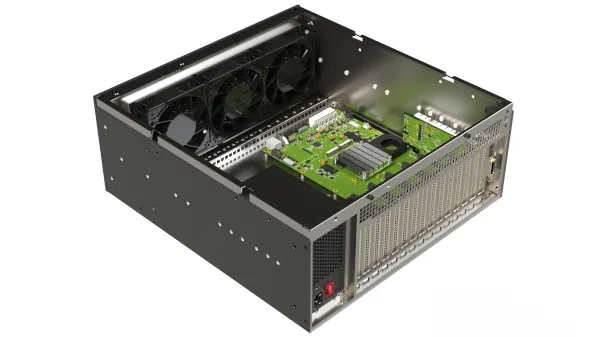
PCIe expansion chassis and backplanes integrated with compatible Dolphin adapters and switches for external GPUs, FPGAs, storage and instrumentation.

Dolphin PCIe host and target adapters for transparent expansion and NTB host-to-host links across selected Gen3, Gen4 and Gen5 interfaces.