
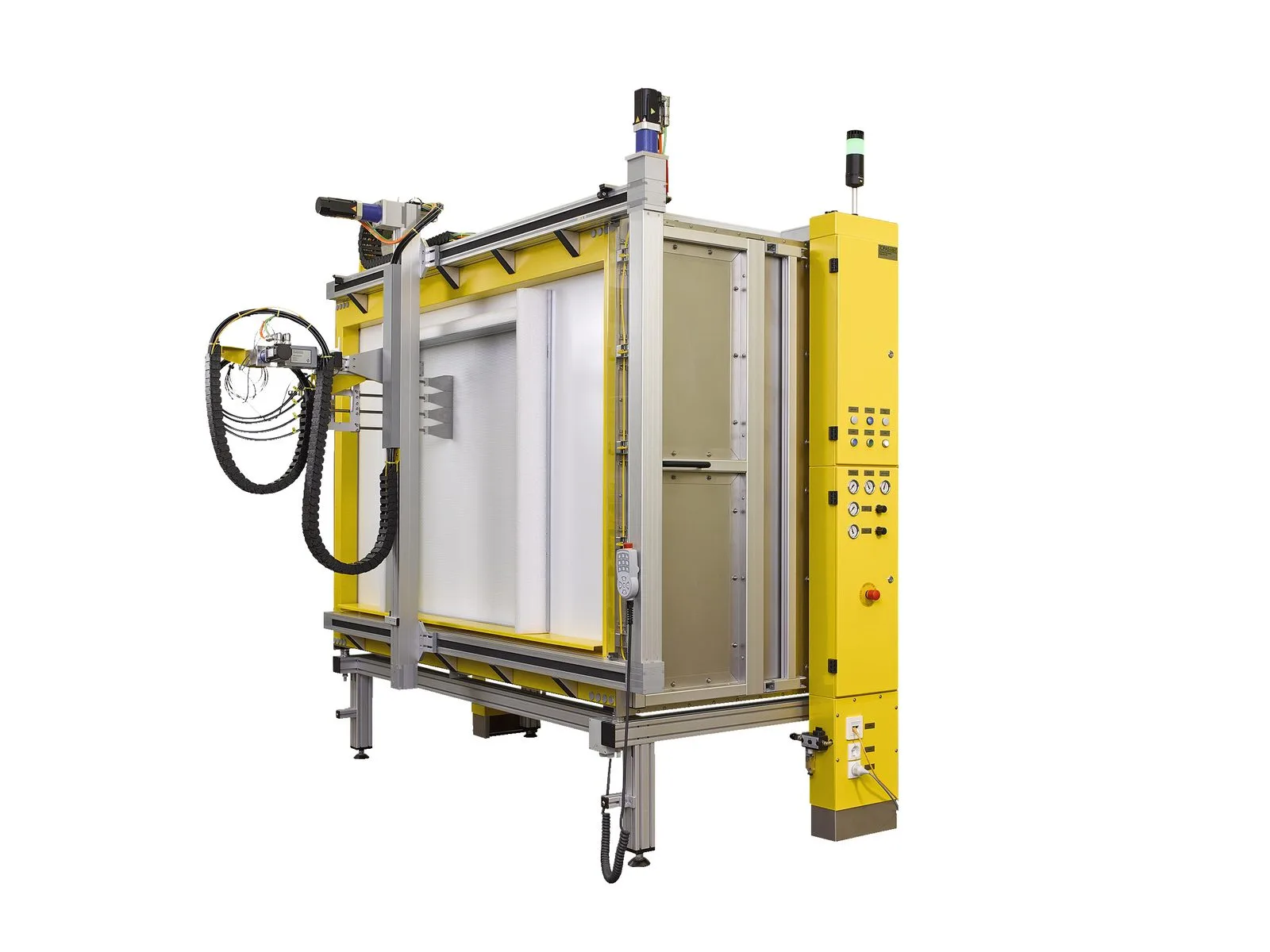
AFS 150 Automated HEPA/ULPA Filter Scanning System
Fully automated production test system for scanning HEPA and ULPA filter elements, detecting local leaks and determining integral filtration efficiency according to ISO 29463 and EN 1822.
Model Overview
| Model | System role | Primary measurements | Standards / application fit |
|---|---|---|---|
| AFS 150 | Fully automated HEPA/ULPA production scanner | Local leak detection, filtration-efficiency calculation and graphical scan results | Automated filter classification and production quality control |
Key Features
Fully automated scan process
Motorised scanning and test control reduce operator dependency and improve repeatability.
Parallel concentration measurement
Separate upstream and downstream particle counters continuously measure challenge and clean-air concentrations.
Graphical leak detection
Downstream particle counts are mapped to identify possible local leaks across the filter surface.
Multiple scan probes
Configurations with multiple probes can shorten cycle time for production testing.
Flexible filter adapters
The specimen holder can be configured for different filter sizes and geometries.
Standard-compliant reporting
AFS150Win controls the system and generates traceable ISO/EN test reports.
Technical Specifications
| Parameter | Unit | Value / Description |
|---|---|---|
| TEST PERFORMANCE | ||
| Test flow rate | m³/h | 120–5,000 |
| Differential-pressure range | Pa | Up to 1,000 |
| Maximum specimen size | mm | 1,830 × 1,220 × 300 |
| Test aerosols | — | DEHS and PSL |
| SYSTEM | ||
| Measurement concept | — | Continuous upstream and downstream particle counting |
| Scanning | — | Automated traverse with downstream sampling probe |
| Compressed-air supply | bar | 6 |
| Power supply | — | 3 × 400 VAC, 100 A |
Values shown are based on the standard system configuration. Confirm the final test method, specimen fixtures, instrumentation, utilities and calibration scope before order placement.
Applications
HEPA/ULPA classification
Automated standard-compliant testing of filter elements during manufacturing.
Local leak detection
Graphical identification of leaks across the filter face.
Integral efficiency
Calculation of overall filtration efficiency from upstream and downstream counts.
Filter design comparison
Repeatable scanning and efficiency testing across filter variants.


