
PCIe Host & Target Adapters
Create the physical and logical bridge between a host, a remote device domain or another computer while choosing transparent access or isolated NTB communication.
System Capabilities
Transparent remote-device access
Extend one host to compatible external endpoints while retaining supported PCIe drivers.
Independent-host communication
Connect separate computers through NTB without combining their boot and address domains.
Workload-matched links
Select PCIe generation, lane width and media according to the required sustained traffic and installation distance.
Direct or switched deployment
Use the same adapter roles in point-to-point expansion or larger managed fabrics through compatible MXS524, MXS924 or MXS824 switch platforms.
Technical Features
PCIe 5.0 families
MXH530/MXH532 use quad SFF-8614 ports, while MXH570/MXH572 use a single x16 CDFP CopprLink interface. The MXH540/MXH542 FireFly optical family provides MPO-connected Gen5 links up to 100 m. Confirm current availability and the final cable set for Gen5 CopprLink and FireFly configurations.
PCIe 4.0 families
MXH930/MXH932 provide x16 Gen4 SFF-8644 connectivity, while MXH940/MXH942 use FireFly optical engines. Additional x4 and x8 Gen4 models support narrower or fan-out topologies.
PCIe 3.0 continuity
MXH and PXH families support deployed Gen3 systems, including standard PCIe and selected embedded form factors.
Transparent host and target roles
A transparent host adapter extends one root complex to compatible remote endpoints. The target side terminates the link and remains under the host's enumeration domain.
NTB host-to-host networking
NTB adapters keep root complexes independent and provide translated memory windows, DMA, interrupts and eXpressWare software interfaces.
Clock isolation and cabling
Supported adapters isolate host and cable clocks. The selected connector, media and lane mapping must match at both ends of the link.
Specifications
| Parameter | Unit | Value / Description |
|---|---|---|
| ADAPTER ARCHITECTURE | ||
| Operation mode | — | Transparent host/target expansion or NTB host-to-host networking. |
| PCIe generations | — | Gen3, Gen4 and Gen5 product families. |
| Host edge width | lanes | x4, x8 or x16 depending on model. |
| Cable ports | — | One or more x4 links aggregated as x8 or x16, depending on adapter. |
| PHYSICAL INTERFACES | ||
| Gen5 copper | — | SFF-8614 with four x4 ports, or CDFP CopprLink with one x16 port; current passive-copper reach is up to 3 m. |
| Gen5 optical | — | FireFly optical engines with MPO connectors on selected adapters; Gen5 reach up to 100 m and selected Gen4 reach up to 200 m. |
| Gen4 / Gen3 | — | SFF-8644 copper up to 5 m, SFF-8644 active optical up to 100 m, FireFly optical up to 200 m on selected Gen4 models, plus legacy iPass interfaces. |
| Form factors | — | Standard PCIe cards plus selected XMC, PXIe and CompactPCI Serial implementations. |
| SYSTEM FIT | ||
| Endpoint compatibility | — | Driver, BAR size, reset, hot-plug and peer-to-peer behaviour must work through the selected topology. |
| Host resources | — | BIOS enumeration and MMIO allocation can limit large GPUs, FPGAs and multi-device systems. |
| Software | — | Transparent links use supported native endpoint drivers and Dolphin board-management software; NTB operation uses compatible eXpressWare components and licensing. |
| Performance | — | Negotiated generation, width, cable media and switch hops determine available bandwidth and latency. |
Applications
HPC and AI
Connect independent compute nodes with NTB adapters or extend GPUs and storage transparently from a controlling host.
Test and measurement
Place digitizers, FPGA cards and instrument interfaces outside the controller while retaining compatible native drivers.
Aerospace and defence
Build cabled PCIe links among servers, embedded computers, PXIe and CompactPCI Serial platforms in system-qualified installations.
Automotive development
Interconnect HIL, logging and sensor-processing platforms for laboratory validation and high-rate data workflows.
Medical and scientific imaging
Separate acquisition and acceleration cards from compact operator systems while maintaining a high-bandwidth device path.
Low-latency server communication
Use NTB fabrics with SISCI, SuperSockets or IPoPCIe for tightly coupled applications in a controlled local environment.
Technical reading for this system decision
Open the original Dolphin or Dolphin-partner document directly. Confirm current model and software compatibility separately for the selected configuration.
Recommended System Architectures
See how this product family fits into transparent expansion, multi-host fabrics and managed-resource systems.
Related Products
Dolphin product portfolio →
Dolphin copper and optical PCIe links using model-specific SFF, CopprLink or FireFly interfaces for rack-scale and remote I/O connectivity.
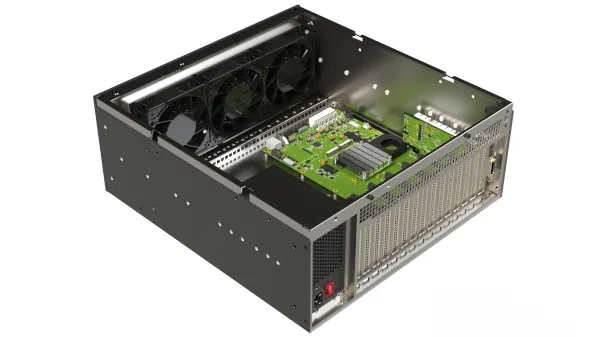
PCIe expansion chassis and backplanes integrated with compatible Dolphin adapters and switches for external GPUs, FPGAs, storage and instrumentation.

Dolphin eXpressWare software with SISCI, SuperSockets, IPoPCIe, reflective memory and SmartIO capabilities on supported systems.