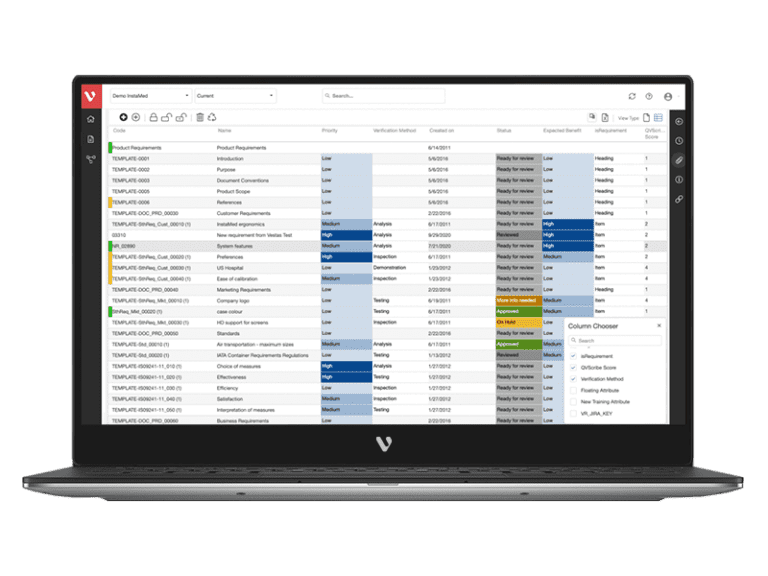
Govern requirements, change and traceability across the lifecycle.

Establish a controlled repository for requirements, risks, verification artefacts, decisions and change, with traceability defined by the project information model.

Requirements qualityBidirectional traceabilityBaselines & changeRisk and test linkage

Technical scope

Requirements are an engineering control system, not a document repository.

The value comes from information architecture, ownership, relationship rules, review gates and change discipline. The platform supports the model; engineering ownership defines and governs it.

Structured requirements

Define typed artefacts, attributes, hierarchies, templates and project-specific information models.

Traceability architecture

Connect needs, system and software requirements, risks, tests, defects and design artefacts using governed link rules.

Change and baselines

Control versions, approvals, baselines, change requests and impact analysis across releases and variants.

Risk and test context

Keep risk controls and verification activity connected to the requirements they address.

Reuse and variants

Manage shared components and controlled reuse without losing project-specific context.

Review and reporting

Support formal review workflows, dashboards, reports and audit preparation based on configured project data.

Implementation workflow

A practical implementation sequence

The implementation should be aligned with the existing engineering process, toolchain and ownership model.
  1. 01Capture intent
  2. 02Structure artefacts
  3. 03Define relationships
  4. 04Review and baseline
  5. 05Manage change
  6. 06Generate controlled reports

Available capabilities

Platforms and specialist tools

Each capability addresses a defined part of the engineering lifecycle.

Technology

Visure Requirements ALM Platform

Centralized requirements, risk, test, change and traceability workflows for complex systems development.
Technical page

Evaluation criteria

Requirements to confirm before evaluation

Base the evaluation on the real application, interfaces, target environment and assurance requirements.
  • Existing requirements sources and migration quality
  • Information model, taxonomy and link semantics
  • Review, approval and baseline governance
  • ReqIF and toolchain exchange needs
  • User roles, deployment and access control
  • Reporting, audit and long-term administration

Relevant engineering frameworks

ISO 26262IEC 61508IEC 62304DO-178CAutomotive SPICEIEC 62443

Technical evaluation and deployment support.

Primionics supports requirements definition, evaluation planning, configuration and integration with the existing development environment.

Assess

Map the current toolchain, lifecycle constraints, evidence gaps and deployment scope.

Architect

Define platform scope, integrations, data ownership, pilot criteria and technical risks.

Enable

Support evaluation, installation, configuration, workflow integration and user adoption.

Sustain

Establish governance, review cadence, upgrades, support escalation and expansion logic.