PCIe Switches & Fabrics
Scale PCIe beyond one cable or one host by creating managed paths between computers, expansion systems, accelerators, storage and I/O endpoints.
System Capabilities
Additional ports and endpoints
Connect multiple hosts, expansion systems, accelerators or storage devices through a managed switching layer.
Transparent and NTB topologies
Support one-root-complex expansion or communication among independent hosts, depending on adapters and configuration.
Configurable lane allocation
Group x4 ports into wider links where the switch and connected hardware support the required mapping.
Central link visibility
Use supported management interfaces to inspect topology, negotiated links and selected PCIe errors.
Technical Features
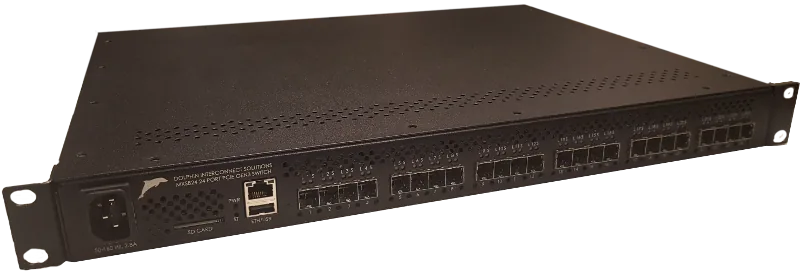
MXS524 Gen5 switch
A preliminary 1U PCIe 5.0 platform with 24 non-blocking x4 SFF-8614 ports. Up to four ports can be aggregated as an x16 link, providing up to 512 GT/s signalling per aggregated connection. Current published cable limits are up to 2 m copper and 100 m optical for this switch.
MXS924 Gen4 switch
A 1U PCIe 4.0 platform with 24 x4 SFF-8644 ports. Compatible ports can be grouped as x8 or x16 and used with transparent or NTB adapter families.
MXS824 Gen3 switch
A 1U PCIe 3.0 switch with 24 non-blocking x4 SFF-8644 ports, 32 GT/s signalling per x4 port and aggregation up to x16.
Transparent I/O fan-out
Connect one root complex to multiple remote endpoints or expansion systems while retaining native PCIe transactions.
NTB multi-host fabrics
Connect independent root complexes through NTB adapters for memory, messaging and software-defined communication.
Port aggregation and topology
Combine x4 ports as x8 or x16 and interconnect switches for larger fabrics. Oversubscription and hop count must be reviewed.
Management and firmware scope
Ethernet management supports firmware updates, configuration and status monitoring. Partitioning, failover and other advanced multi-host functions are firmware- and release-dependent and must be confirmed for the selected platform.
Specifications
| Parameter | Unit | Value / Description |
|---|---|---|
| SWITCH PLATFORMS | ||
| MXS524 | — | 1U PCIe 5.0 switch with 24 non-blocking x4 SFF-8614 ports; up to four ports may be aggregated as x16. |
| MXS924 | — | 1U PCIe 4.0 switch with 24 x4 SFF-8644 cable ports. |
| MXS824 | — | 1U PCIe 3.0 switch with 24 non-blocking x4 SFF-8644 ports. |
| Port aggregation | lanes | One x4, two-port x8 or four-port x16 connections, subject to the switch generation, firmware and cable mapping. |
| Adapters | — | Transparent and NTB adapter families matched to generation and cable interface. |
| FABRIC DESIGN | ||
| Traffic models | — | Host-to-device, host-to-host, peer-to-peer or mixed traffic. |
| Scale | — | Node count, switch count, hop count and simultaneous bandwidth. |
| Oversubscription | — | Aggregate endpoint traffic must fit the selected uplinks and switch paths. |
| Clocking | — | Clock isolation and cable-link clock handling depend on adapters and switch configuration. |
| OPERATIONS | ||
| Management | — | Ethernet-based configuration, monitoring and diagnostics on supported switch platforms. |
| Partitioning | — | Logical topology and advanced multi-host features depend on firmware and product configuration. |
| Recovery | — | Define link-loss, host restart, switch restart and topology reinitialisation behaviour. |
| Compatibility | — | All adapters, cables and switches must support the required generation, lane width and port mapping. |
Applications
Compute clusters
Create low-overhead PCIe communication fabrics for shared memory, sockets or direct-memory transfers between servers.
Accelerated systems
Fan out GPU, FPGA and acquisition resources to remote hosts or expansion domains using validated topology and ownership rules.
NVMe and storage paths
Build high-rate PCIe storage connections while accounting for peer routing, host resources and failure recovery.
Automated test
Aggregate controllers, PXIe chassis and external acquisition hardware across multiple racks.
Simulation platforms
Distribute state, sensor and actuator data among real-time, visualisation and recording nodes.
Data-intensive services
Scale tightly coupled caching, replication and analytics systems where local-fabric latency and bandwidth justify PCIe networking.
Technical reading for this system decision
Open the original Dolphin or Dolphin-partner document directly. Confirm current model and software compatibility separately for the selected configuration.
Recommended System Architectures
See how this product family fits into transparent expansion, multi-host fabrics and managed-resource systems.
Related Products
Dolphin product portfolio →
Dolphin copper and optical PCIe links using model-specific SFF, CopprLink or FireFly interfaces for rack-scale and remote I/O connectivity.
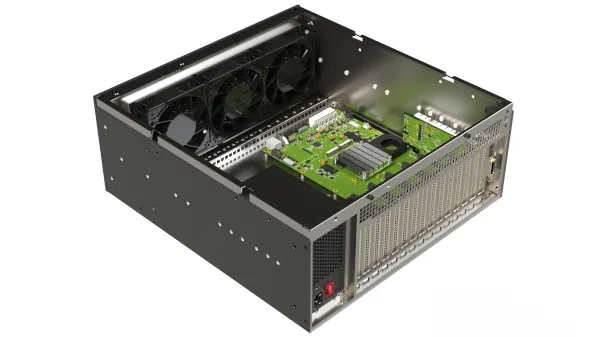
PCIe expansion chassis and backplanes integrated with compatible Dolphin adapters and switches for external GPUs, FPGAs, storage and instrumentation.

Dolphin eXpressWare software with SISCI, SuperSockets, IPoPCIe, reflective memory and SmartIO capabilities on supported systems.