
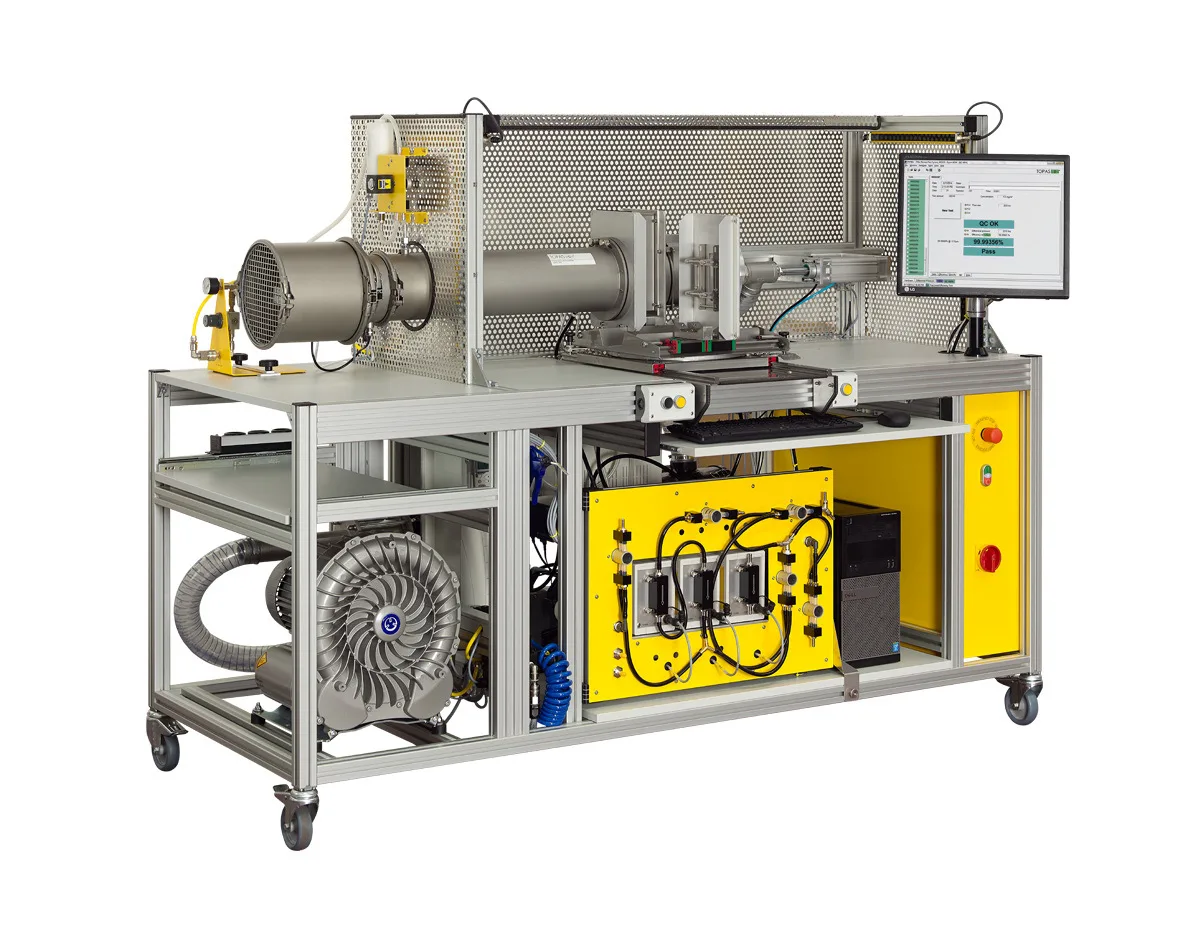
AFC 132 QC HEPA Production Quality-Control Test System
Automated production quality-control system for integral efficiency and leakage testing of small HEPA filter elements that cannot be scanned, with approximately 30-second cycles and pass/fail evaluation.
Model Overview
| Model | System role | Primary measurements | Standards / application fit |
|---|---|---|---|
| AFC 132 QC HEPA | Automated small-HEPA production test system | Integral filtration efficiency, pressure drop and leakage-related pass/fail evaluation | Production quality control for non-scannable small HEPA elements |
Key Features
Fast production cycle
Supply, measurement and result evaluation are designed for approximately 30-second test cycles.
Integral efficiency method
Determines integral efficiency for filter geometries that cannot be scanned reliably.
Configurable pass/fail criteria
Nominal efficiency targets can be configured for different HEPA product classes.
Low aerosol loading
The particle-counting method minimises test-aerosol loading compared with visual oil-thread procedures.
Exchangeable adapters
Customer-specific filter adapters support different small-element geometries.
High automation
The compact system is designed for 24/7 production use with limited operator interaction.
Technical Specifications
| Parameter | Unit | Value / Description |
|---|---|---|
| TEST PERFORMANCE | ||
| Test flow rate | m³/h | 25–130 |
| Test cycle duration | s | 30 |
| Differential-pressure range | Pa | 0–3,000 |
| Maximum specimen size | mm | 300 × 300 × 300 |
| SYSTEM | ||
| Test aerosols | — | DEHS and other customer-specific aerosols |
| Particle measurement | — | Parallel upstream and downstream optical particle counters |
| Power supply | — | 3 × 400 VAC, 50/60 Hz, 16 A |
| Dimensions | mm | 2,000 × 1,500 × 1,000 |
Values shown are based on the standard system configuration. Confirm the final test method, specimen fixtures, instrumentation, utilities and calibration scope before order placement.
Applications
Small HEPA filter QC
Rapid integral-efficiency testing during filter-element production.
Nominal class confirmation
Comparison of measured efficiency against configured product-class limits.
Pass/fail inspection
Automated identification of defective filter elements before shipment.
Traceable production data
Repeatable results suitable for integration into production quality records.


